



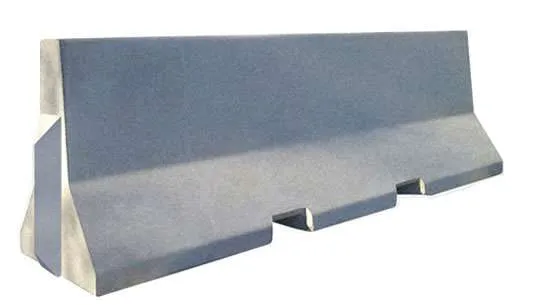
When it comes to high-velocity traffic management and critical infrastructure protection, the Jersey barrier remains the industry’s most trusted defensive tool. While plastic versions offer portability, the “Type 1” precast concrete barrier is the gold standard for projects requiring absolute physical resistance. Understanding the standard jersey barrier dimensions is essential for engineers and site planners. A standard 8-foot unit typically features a 27-inch wide base tapering to a narrower top at a height of 32 inches. This specific geometry—originally developed in the 1950s—is designed to minimize vehicle damage during a collision by allowing the wheels of a car to ride up the lower slope, which helps redirect the vehicle back into its lane rather than allowing it to vault over the barrier or stop abruptly.
Type 1 Specifications and Portability
Despite their massive weight (often exceeding 4,000 lbs for an 8-foot section), modern precast barriers are designed with logistical efficiency in mind:
- Forklift Slots: Integrated notches at the base allow for easy movement with heavy machinery, making them “portable” for multi-phase highway projects.
- Reinforced Concrete: These units are cast with high-strength concrete and internal steel rebar, ensuring they can withstand multiple impacts without losing structural unity.
- Slope Geometry: The “F-Shape” or New Jersey profile is specifically engineered to handle the center of gravity of modern SUVs and trucks, providing a higher level of crossover prevention.
Applications in Perimeter Defense
Beyond the highway, these barriers are increasingly used for “hard” perimeter security at government buildings, airports, and military installations. Their mass provides an immediate deterrent against vehicle-borne threats, while their height blocks line-of-sight into sensitive areas. For projects where permanent installation isn’t required, these barriers can be placed on the surface without anchoring, relying on their sheer weight to maintain position.
Sourcing Industrial-Grade Protection
Selecting the right barrier requires a deep understanding of site-specific threats and traffic patterns. Working with a provider that offers both concrete and water-filled plastic options allows for a hybrid approach to site security. By consulting with experts at Epic Crowd Control, project leads can secure the specific Type 1 barriers needed to meet DOT standards and protect both workers and the public. In the world of high-impact safety, there is no substitute for the mass and engineering of a true Jersey barrier.
